Introduction: Why Does a Handcrafted Piece Cost More — and Why Is It Worth Every Rupee?
You have seen it happen. Two necklaces sit side by side. One costs a fraction of the other. They look similar at first glance — same style, same shine, same general shape. Yet one carries a price tag that is three, four, sometimes five times higher than the other. And if you ask the jeweller behind the counter why, they will say two words: handcrafted quality.
But what does that actually mean? Is the premium on handcrafted jewellery genuinely justified — or is it simply a marketing story designed to make you feel better about spending more?
The answer, when you understand what truly goes into a handcrafted piece, is unambiguous. Handcrafted jewellery is not just more expensive — it is fundamentally different. Different in how it is made, in the materials used, in how it behaves against your skin, in how it ages over years of daily wear, and crucially — in how much of its value it retains over time.
At Grihiva, handcrafted quality is not a selling point. It is the foundation of everything we create. We are a fine jewellery brand built on the belief that everyday jewellery — the pieces you wear from morning to night, day after day — deserves the same level of craftsmanship as the most special occasion piece in your collection. In this article, we explain exactly why handcrafted jewellery commands a premium, why that premium holds its value, and why it is the only kind of jewellery truly worth wearing every single day.
1. The Human Hand Creates What Machines Simply Cannot
The most fundamental difference between handcrafted and mass-produced jewellery is not price — it is process.
Mass-produced jewellery is made using industrial moulds and automated machinery that can stamp out thousands of identical pieces per hour. Metal is poured into a mould, cooled, polished by machine, and sent down a production line where stones are set by automated tools calibrated for speed rather than precision. The result is a piece that looks correct from a distance but reveals its shortcuts up close — micro-imperfections in the setting, slight asymmetries in the metalwork, stones that sit fractionally off-centre, finishes that feel smooth but lack depth.
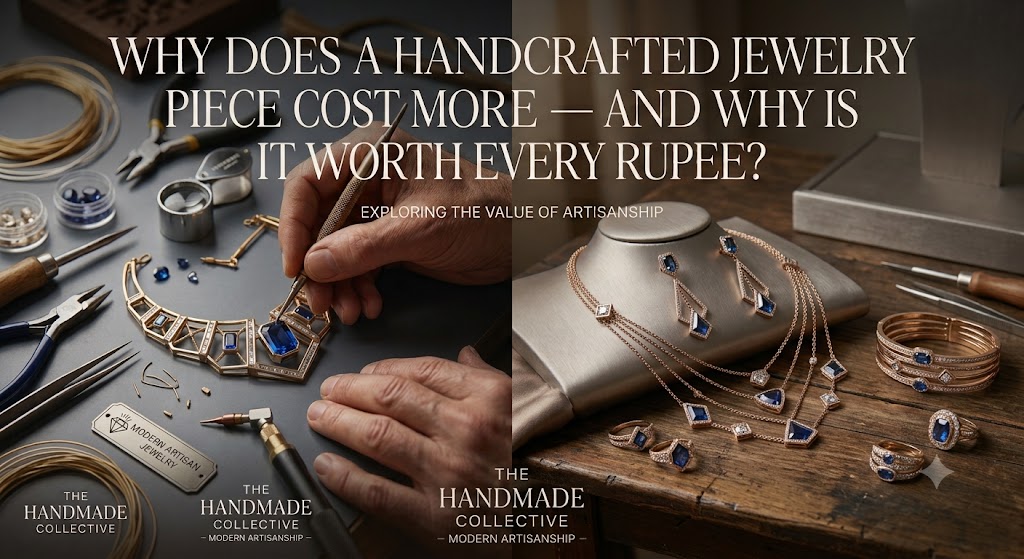
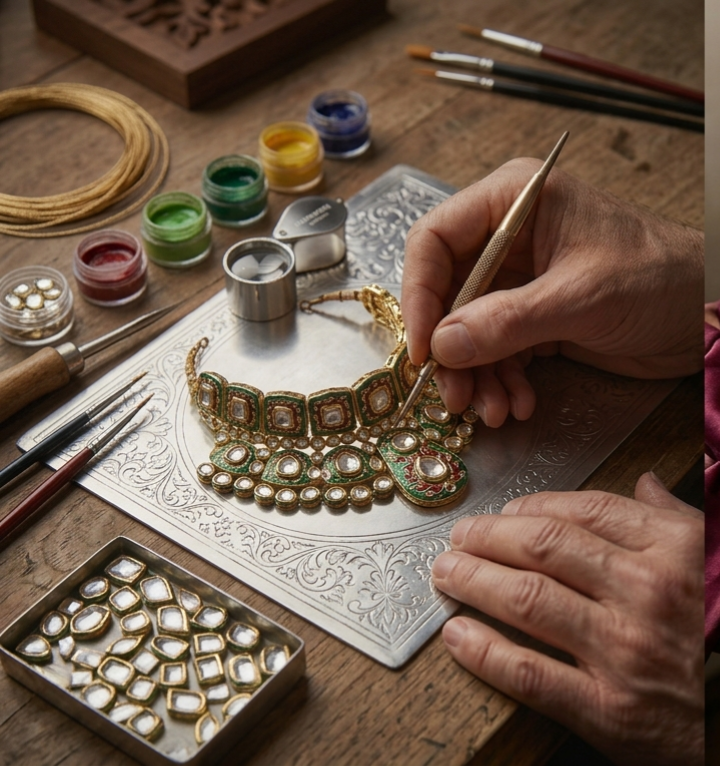
A handcrafted piece begins differently — with a skilled artisan, a vision, and hours of deliberate, focused work. The metal is shaped by hand. Each curve, each angle, each texture is formed through a process that combines technical mastery with genuine artistic judgment. Stones are individually selected and set by hand, each one examined for how it interacts with this specific piece of metal, this specific design, in this specific light.
The result is jewellery that has a quality of presence that no machine can replicate. When you hold a handcrafted piece, you feel the difference before you can articulate it — a weight and solidity in the metal, a precision in the settings, a finish that rewards close attention rather than concealing imperfections. That is the irreplaceable value of the human hand — and it is precisely why handcrafted jewellery commands the premium it does.
2. Superior Materials — Because Shortcuts Are Not an Option
Handcrafted jewellery and premium materials are inseparable. When an artisan is investing hours of skilled labour into a single piece, using inferior materials is both a creative and a commercial impossibility. You do not spend ten hours perfecting a setting and then fill it with a stone that cannot hold its brilliance. You do not hand-finish metal to a mirror polish and then alloy it with metals that will tarnish, fade, or worse — irritate the skin of the person wearing it.
This is where Grihiva’s philosophy becomes critical to understand. We are a fine jewellery brand focused on high-quality everyday jewellery that does not hurt your skin. That commitment begins at the material level — before a single piece is designed, before a single stone is selected, before a single artisan picks up a tool.
Every material we use is chosen with two non-negotiable requirements: it must be beautiful, and it must be safe for daily skin contact. That means no nickel. No cheap alloys that leach into the skin over hours of wear. No coatings that look fine on day one but begin to flake or fade within weeks. Our metals are chosen for purity, durability, and skin compatibility — because everyday jewellery that irritates your skin is not fine jewellery. It is a problem disguised as a product.
Mass-produced jewellery almost universally compromises on materials — because at the volumes and price points it targets, genuine quality materials make the economics impossible. Handcrafted jewellery, by contrast, earns its premium by refusing to compromise, and that refusal begins with what the piece is actually made of.
Here is a truth that every jewellery buyer discovers eventually, sometimes painfully: how a piece looks when you buy it and how it looks after two years of daily wear are two very different things.
Mass-produced jewellery is engineered for point-of-sale appeal. It is designed to look its best in a display case under flattering lighting, in the first few weeks of ownership when the surface coating is intact and the metal has not yet been exposed to the reality of daily life — sweat, moisture, friction, skin oils, cleaning products. Once that initial gloss fades, the shortcuts reveal themselves. Plating wears away to expose base metal. Stone settings loosen because they were set by machine with no individual adjustment for that specific stone. Clasps weaken. Surfaces scratch in ways that cannot be polished out without destroying the coating underneath.
A handcrafted piece is built to be worn. The metal is worked to a structural density that resists daily wear. Settings are checked and adjusted by hand so that each stone is held with precisely the right tension — secure enough to last years of movement and activity, positioned precisely enough to maximise how the stone catches light. Finishes are applied to the actual metal surface rather than layered over a base metal, which means they can be professionally re-polished years later and look as extraordinary as the day the piece was made.
At Grihiva, we design specifically for daily wear — for the client who puts a piece on in the morning and does not think about it again until they choose to take it off. That requires a level of structural integrity and material quality that only handcrafted production can deliver. Our pieces are not designed to survive occasional wear in controlled conditions. They are designed to thrive in the reality of your daily life.
4. The Investment Argument: Handcrafted Jewellery Holds Its Value
Beyond beauty and wearability, there is a compelling financial argument for handcrafted fine jewellery that many buyers overlook entirely — value retention.
Mass-produced jewellery depreciates rapidly, often dramatically. The moment a machine-made piece leaves the store, its resale value collapses — because it is one of thousands of identical pieces, made with materials chosen for cost rather than quality, and its condition deteriorates in ways that make resale difficult. Trying to sell a mass-produced jewellery piece two years after purchase is a sobering experience.
Handcrafted fine jewellery behaves differently for several interconnected reasons.
Material integrity: Handcrafted pieces use higher-purity precious metals and better-quality stones — materials that hold intrinsic value independently of the piece’s condition. Gold is gold. A well-cut diamond is a well-cut diamond. These materials do not depreciate the way synthetic coatings and alloy-heavy base metals do.
Rarity: A handcrafted piece is, by definition, one of a very limited number of examples. Unlike a mass-produced item that exists in the tens of thousands, a handcrafted piece has a scarcity that supports its value over time. The rarer something is, the more stubbornly it holds its worth.
Condition over time: Because handcrafted jewellery is built to last and can be professionally restored without losing its fundamental integrity, well-maintained handcrafted pieces retain their appearance — and therefore their value — for decades. Heirloom jewellery is almost always handcrafted. There is a reason for that.
Craftsmanship as an asset: As skilled artisan jewellers become rarer globally — a trend that is already well underway — the labour component of handcrafted jewellery is itself appreciating. The hours of skilled human work embedded in a handcrafted piece represent a cost that is increasingly difficult to replicate, and that scarcity supports long-term value.
5. Wearing Something Made Specifically for You
There is a dimension of handcrafted jewellery that no financial or technical argument can fully capture — the experience of wearing something made with intention, skill, and genuine human attention.
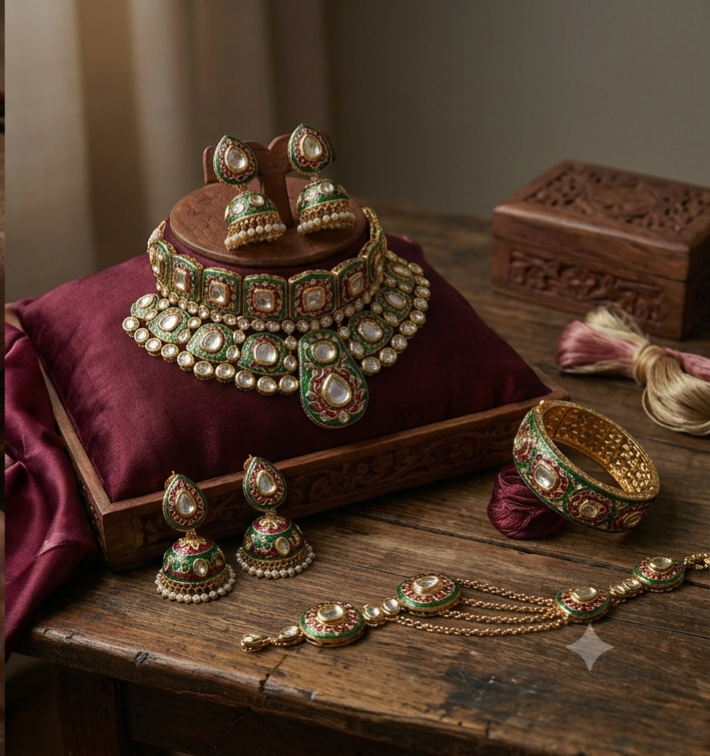
Every handcrafted piece from Grihiva carries within it the hours a skilled artisan spent making decisions — about proportion, about how this curve meets that angle, about how the setting positions this particular stone to catch morning light differently from afternoon light. These are not decisions an algorithm makes. They are not calibrations an automated machine arrives at. They are the judgments of a human craftsperson who understands both the technical requirements of fine jewellery and the aesthetic experience of the person who will ultimately wear it.
When you put on a handcrafted piece in the morning — the kind of piece designed to sit against your skin all day without causing irritation, without feeling heavy, without announcing itself in uncomfortable ways — you are wearing the accumulated skill and judgment of that artisan. That is an experience that mass production, by its very nature, cannot provide. And for clients who have experienced both, it is an experience they rarely choose to give up.
6. Everyday Luxury — The Grihiva Philosophy
The jewellery industry has long operated on a false assumption: that truly fine, truly handcrafted, truly premium jewellery is for special occasions — for anniversaries, for ceremonies, for glass display cases and careful storage boxes.
At Grihiva, we reject that assumption entirely.
We believe that the jewellery you wear every day — the pieces in constant contact with your skin, the ones that move with you through your whole life — deserve to be the finest pieces you own. Not the cheapest. Not the most convenient to replace when they inevitably deteriorate. The finest.
That is why every Grihiva piece is handcrafted to the standards of fine jewellery, made from materials that are safe and beautiful against your skin for all-day wear, designed to improve with age rather than betray its shortcuts over time, and priced to reflect genuine value rather than the inflated margins of luxury branding or the false economy of disposable fashion jewellery.
Our clients are not people who buy jewellery to impress others at occasional events. They are people who love jewellery enough to want it as a constant, comfortable, beautiful presence in their daily life. They have learned — sometimes through disappointing experience with mass-produced pieces — that the premium for handcrafted quality is not a cost. It is a saving. Because one Grihiva piece, worn daily for ten years, costs a fraction of the rotating parade of mass-produced pieces it replaces.
Conclusion: The Premium Is Not the Price — It Is the Value
Understanding why handcrafted jewellery commands a premium means understanding a simple truth: the price of a piece of jewellery and its value are not the same thing.
A mass-produced piece may cost less at the point of purchase. But it costs more in replacements, more in skin irritation, more in the subtle daily disappointment of wearing something that looked beautiful in a store and ordinary on your wrist three months later.
A handcrafted piece from Grihiva costs more upfront — and less in every way that matters over time. It holds its beauty. It holds its value. It holds its place against your skin without causing harm. And it holds your attention, year after year, in ways that machine-made jewellery simply cannot.
That is why handcrafted jewellery commands a premium. And that is why — once you truly understand what that premium represents — you will understand why it is worth every single penny.